

E-Challan Scam: How to Identify Fake Challan Messages and Verify Your Fine
Received an SMS or WhatsApp message saying that your vehicle has an unpaid “e-Challan detected for GJ01XX1234. Fine: ₹1,000. Pay within 24 hours to avoid court summons. Click here: bit.ly/pay-traffic-fine.”
Your heart sinks. You remember driving through that busy intersection yesterday. You see your actual license plate number in the text, so it must be real, right? Stop. Before you click that link, you need to know that you are likely the target of the most sophisticated “fearware” scam. Do not use the payment link provided in the message before verifying it. Fake websites and mobile applications have been used to impersonate e-Challan services. The safest approach is to independently open the official e-Challan service and verify the challan using your vehicle or challan details.
What Is the Fake Traffic Challan Scam?
The Fake Traffic Challan Scam is a form of “phishing”—a digital trick where criminals pretend to be a trustworthy authority (like the Traffic Police) to steal your sensitive information.
In this specific scam, fraudsters send out mass text messages or WhatsApp alerts claiming that your vehicle has been caught violating a traffic rule. These messages are designed to look 100% official. They often include a “Challan Number,” the specific amount of the fine, and a link that leads to a fake website that looks exactly like the government’s Parivahan Sewa portal.
Unlike a real fine, which is meant to penalize a driving error, this scam has two malicious goals:
- Financial Theft: To trick you into paying a “fine” that goes directly into the scammer’s bank account.
- Data Harvesting: To steal your credit card details, net banking credentials, or even install “malware” on your phone when you click the link.
Essentially, the scammers are “fishing” for victims. They send out thousands of these messages, knowing that out of every hundred people, a few will be worried enough to click and pay without double-checking.
In this guide, we will break down how scammers are turning your vehicle’s identity into a weapon and how you can protect your hard-earned money from the digital highwaymen.
-
The Psychology of Fear: Why We Fall for It:
The E-Challan scam doesn’t work because people are “uninformed”; it works because it triggers our fight-or-flight response. Scammers use three specific psychological triggers:
- Accuracy: They often include your real vehicle registration number (which they get from leaked databases or public scraping). Seeing your license plate makes the message feel personal and official.
- Urgency: The threat of a “Court Summons” or “License Suspension” creates panic. When we are scared, the logical part of our brain shuts down.
- Convenience: By providing a direct link, they offer an “easy way out.” You think, “Let me just pay this ₹500 and get it over with,” not realizing the link is a trap.
-
The Anatomy of a Fake Challan:
Cybercriminals have become master mimickers. A fake challan message today looks almost identical to a genuine one from the Ministry of Road Transport and Highways (MoRTH). However, if you look closely, the cracks start to show.
The Fake URL (The Biggest Red Flag)
Official government websites in India end in .gov.in. Scammers use “look-alike” domains to trick you. For e-Challan verification, use the official Government of India e-Challan service rather than relying on a link received through SMS, WhatsApp or email.
- Real: https://echallan.parivahan.gov.in
- Fake: https://echallan-parivahan-pay.in, https://parivahan-notice.com, or bit.ly/pay-challan
The Card-Only Trap
A massive red flag is the payment gateway. Genuine government portals offer multiple options: UPI, Net Banking, and various Wallets. Scammers, however, often design their fake pages to only accept Credit or Debit Cards. Why? Because they want to “harvest” your card number, CVV, and expiry date to make much larger unauthorized transactions later.
-
How Scammers Get Your License Plate Data:
You might wonder, “How did they know my car number?” Unfortunately, your vehicle data isn’t as private as you think. Scammers gather this info through:
- Public Parking Records: Unscrupulous parking lot operators sometimes sell logs of license plates.
- Scraping Third-Party Apps: Many “Check Vehicle Info” apps have weak security, allowing hackers to pull bulk data.
- Physical Spotting: In some cases, scammers simply take photos of cars in wealthy neighborhoods and send bulk messages to those regions.
-
The “Golden Hour”: What to Do if You Clicked:
If you’ve already clicked the link or, worse, entered your OTP, every second counts. This is what experts call the Golden Hour.
- Step 1: Freeze Everything. Use your bank’s mobile app to “Freeze” or “Block” your credit and debit cards immediately.
- Step 2: Dial 1930. This is the National Cyber Crime Helpline. The official cybercrime portal says: For immediate reporting of financial cyber fraud, call 1930.
- Step 3: Check for Malware. If the link asked you to download an .apk file (common on Android), your phone is likely compromised. Perform a factory reset or use a reputable antivirus scan to remove “Remote Access Trojans” (RATs).
-
How to Verify a Real Challan (The Safe Way):
Never trust a link sent via SMS or WhatsApp. If you want to check if you actually have a fine, follow these steps:
- Go Directly to the Source: Type echallan.parivahan.gov.in manually into your browser.
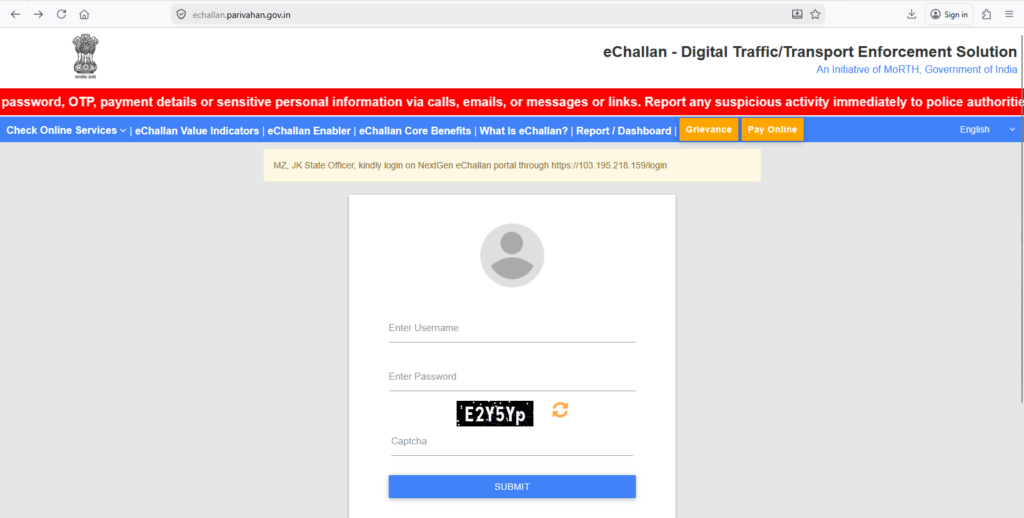
- Use the “Check Challan Status” Feature under Check Online Services Tab: You will need your Vehicle Number AND either the Chassis Number or Engine Number (last 5 digits).
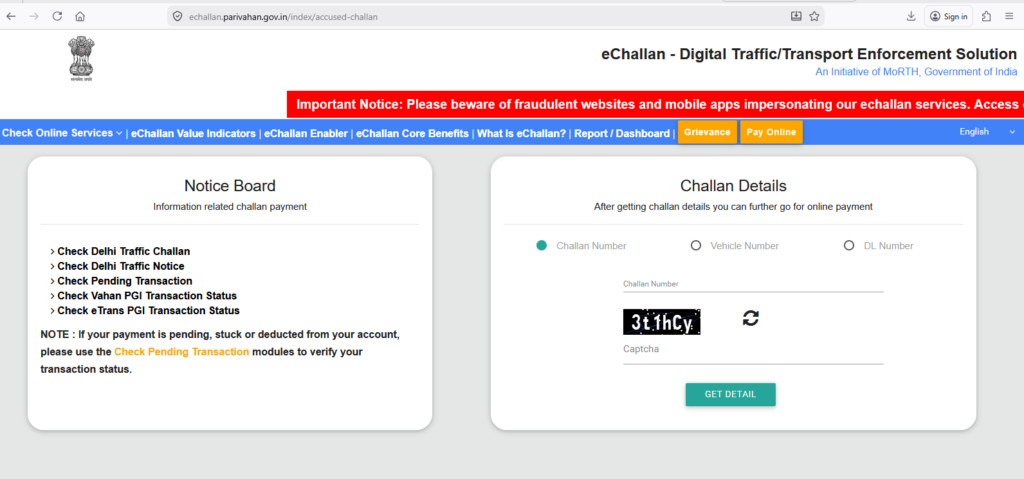
- The “Invalid Number” Test: Do not test an unfamiliar e-Challan website by entering vehicle, Aadhaar, payment or other personal information. Verify the service independently through the official Government of India e-Challan portal.
-
Summary: Your Shield Against Fraud
The “E-Challan Scam” is a reminder that in 2026, your digital safety is as important as your road safety.
| Feature | Genuine E-Challan | Fake Scam Message |
| Sender ID | Usually starts with a Govt code (e.g., AD-TRAFIC) | Random 10-digit mobile number |
| Website Link | Ends strictly in .gov.in | Ends in .com, .in, .net, or shortened URLs |
| Payment Options | UPI, Net Banking, Cards, QR | Often only asks for Card details + OTP |
| Language | Formal and neutral | Threatening, urgent, and full of typos |
7-point scam checklist
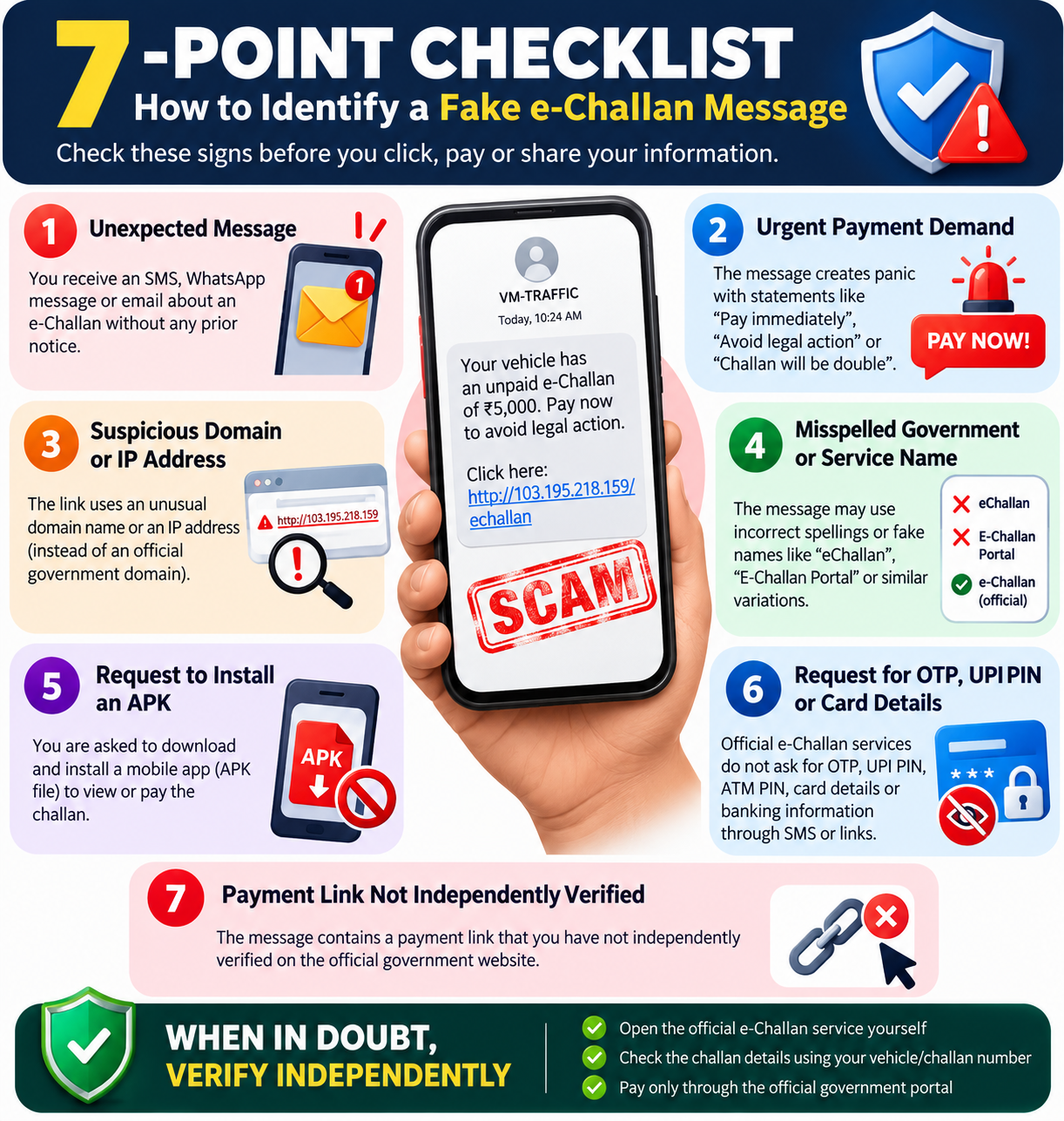
⚠️ Official e-Challan Safety Warning
The Ministry of Road Transport & Highways warns users about fraudulent websites and mobile applications impersonating e-Challan services. Users should access the service only through the official website/app. The official service also states that it does not request passwords, OTPs, payment details or sensitive personal information through calls, emails, messages or links.
Final Thought
Technology is meant to make our lives easier, but it also makes the scammer’s job easier. The next time you get a “Traffic Fine” alert, don’t let the panic take the wheel. Take a breath, close the message, and check the official Parivahan portal yourself.
Stay safe on the roads—and even safer on the web.
Leave a Reply