

Think about your morning routine. Before you’ve even had your first cup of chai, you’ve likely checked your bank balance, replied to a WhatsApp thread, or scanned a UPI code. We are living in a transformed India, one where the physical and digital worlds have blurred into one. But as we’ve moved our lives onto our smartphones, a new breed of predator has followed us.
Cybercrime is no longer just a plot point in a sci-fi thriller; it’s a daily reality on our streets and in our pockets. From sophisticated bank heists to the silent trauma of online harassment, the digital landscape has become a complex battlefield. Understanding this “Digital Wild West” isn’t just for the tech-savvy anymore—it’s an essential survival skill for every Indian citizen navigating the 21st century. Let’s pull back the curtain on how these crimes work and how our laws are evolving to protect us.
What We’re Actually Up Against
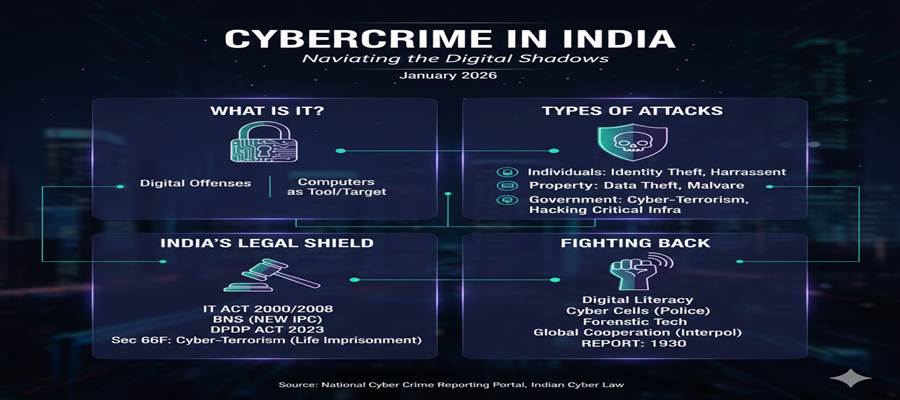
When people hear “cybercrime,” they often think of a genius hacker in a dark room. But in reality, it’s much broader. It’s any crime where a computer or a smartphone is either the weapon (like sending a scam link) or the target (like hacking a bank).
In India, we generally see these threats falling into three buckets. First, there are crimes against you as an individual—things like identity theft or someone hacking your social media. Then there are crimes against property, where someone tries to steal your digital assets or data. Finally, the most serious are crimes against the Government. This is essentially digital warfare, where hackers try to disrupt our national infrastructure, like power grids or defense databases. These aren’t just technical glitches; they are attacks on our country’s sovereignty.
The Human Cost: Harassment and Hacking
One thing we need to talk about more is Cyber Harassment. For a long time, people dismissed online bullying or stalking as “just the internet,” but the law in India has finally caught up. If someone uses the digital space to humiliate, threaten, or stalk you, they are committing a crime. It’s not “just a troll”—it’s a legal offense that the police take seriously.
The same goes for Hacking. While we see “cool” hackers in movies, breaking into someone’s system without an explicit invitation is digital trespassing. Whether it’s a small personal account or a large company database, unauthorized access is a criminal act under our Information Technology (IT) Act.
The New Rules of the Game: BNS and the Legal Shift
If you’ve been following the news, you know that India recently overhauled its entire criminal justice system. As of July 1, 2024, the old Indian Penal Code (IPC) has been replaced by the Bharatiya Nyaya Sanhita (BNS).
This is a huge deal for digital safety. For the first time, “organized crime” specifically includes cybercrime. This means if a gang of scammers is operating a “call center” to trick people out of their savings, they face much harsher penalties than a lone individual would. Our courts are also becoming much more tech-savvy. They no longer just ask for paper trails; they accept WhatsApp chats, emails, and server logs as “primary evidence.” They’ve moved from asking “where is the physical proof?” to “show me the digital footprint.”
Why This Matters: Lessons from the Front Lines
We’ve had some wake-up calls recently. Remember the AIIMS Delhi ransomware attack? It wasn’t just about stolen names; it literally stopped doctors from accessing patient records, proving that a keyboard can be as dangerous as a weapon. Or look at the rise of Deepfakes—AI-generated videos of celebrities and politicians. These cases have shown us that our laws aren’t just “tech rules”; they are our last line of defense in a world where seeing is no longer believing.
How Do We Actually Fight Back?
Building a safer digital India isn’t just about hiring more police. It starts with us.
- Vigilance is Key: We need to stop being so “click-happy.” If a deal looks too good to be true, it’s probably a scam.
- Specialized Training: Every local police station needs a “Cyber Cell” that understands how to track a crypto transaction or a spoofed IP address.
- Report, Don’t Hide: Many victims stay silent because they feel embarrassed. But reporting to the National Cyber Crime Reporting Portal (1930) is the only way to stop these criminals from hitting their next target.
Staying Safe Together
At the end of the day, the internet is simply a mirror of our society—it holds both our greatest innovations and our deepest risks. While India’s legal framework, from the IT Act to the new BNS, provides us with a sturdy shield, the most powerful weapon in our arsenal is our own awareness. We cannot afford to be passive users in an era of Deepfakes and AI-driven scams.
Protecting our “Digital India” is a collective responsibility; it requires us to be skeptical of the suspicious, supportive of victims, and vocal in reporting crimes. As we continue to build this massive digital economy, let’s ensure that our safety evolves as fast as our technology. Stay curious, stay skeptical, and remember: in the digital world, your vigilance is the ultimate firewall.
Leave a Reply